



Resource Center
Communication and sharing promote growth
Joining Hands for Development!
Communication and sharing promote growth
Joining Hands for Development!


On the path toward Exascale AI computing power, Huawei's CloudMatrix 384 Super Node and NVIDIA's GB200 NVL72 cluster have emerged as two globally prominent technological peaks. They not only represent different hardware integration capabilities but also profoundly reveal two fundamental philosophies for building supercomputing systems.
One is metaphorically described as a "sustained high fever," facing the ultimate thermal challenge of densely packed, steady-state heat dissipation from 384 chips operating at full throttle. The other is likened to "intermittent epileptic seizures," requiring the taming of intense, pulsed heat flows generated when 72 top-tier GPUs work in synchrony. These two different "maladies" ultimately lead to entirely distinct "prescriptions"—namely, thermal solutions—and provide us with a clear view of two core engineering philosophies: deterministic systems engineering versus agile ecosystem innovation. For every company in the supply chain involved, understanding this duel is key to defining their future role.
1-The Root of Core Differences – The "Malady" Determines the "Prescription"
From the outset of design, Huawei and NVIDIA embarked on different paths, directly shaping their distinct thermal source characteristics:
Table 1: Comparison of Thermal Source Characteristics Between Two Technical Approaches
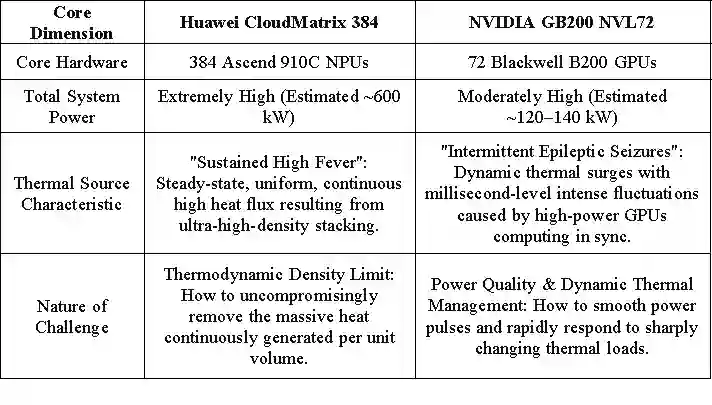
The difference between this "sustained high fever" and "intermittent epileptic seizures" is by no means accidental. It reflects Huawei's choice as a challenger to focus on total system performance, pushing the limits of computing density within a single cabinet at all costs, while NVIDIA, as the leader, faces the task of building an ecosystem that can efficiently collaborate and be widely adopted while maintaining an absolute performance advantage per chip.
2- The Materialization of Engineering Philosophy – Two Liquid Cooling Paths
The two distinct design philosophies are most vividly embodied in their respective liquid cooling solutions, shaping the complete technology stack from the chip to the data center room.
a. Huawei: The Liquid Cooling Practice of Deterministic Systems Engineering
This is a top-down design philosophy born for system-level deterministic goals. Its core lies in treating thermal management as a crucial part of the infrastructure, achieving it through globally integrated, highly reliable engineering, rather than treating it merely as a supporting component.
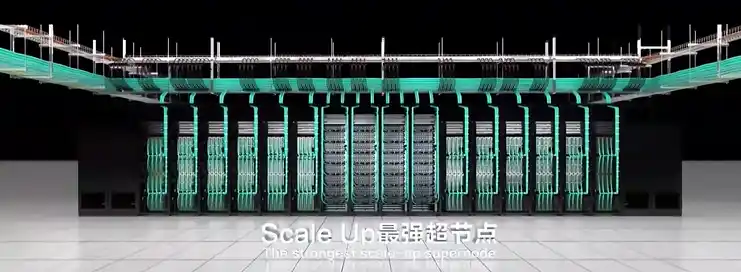
Figure 1: Huawei Ascend 384 Super Node
· Chip-level Precision Engineering and Reliable Connection: To ensure efficient heat transfer from the chip to the cold plate, Huawei focuses on engineering optimization of interface materials. While public information shows its advanced patent reserves in this field (e.g., using high-sphericity silicon carbide fillers), its specific implementation within the super node remains undisclosed. It is certain that its solution inevitably pursues extremely low interfacial thermal resistance and long-term reliability to meet the "sustained high fever" challenge.
· System-level Redundancy and Intelligent Control: Adopts redundant designs, such as ring-shaped liquid supply, and develops in-house Liquid Cooling Thermal Management Units (TMUs) as the system's "central nervous system." This controller enables zero-second switching between pipelines and utilizes AI for failure prediction, ensuring the determinism and reliability of the thermal dissipation chain in a software-defined manner—a hallmark of its systems engineering thinking.
· Infrastructure Convergence ("Cooling-Power Integration"): At the cabinet level, the Liquid Distribution Unit (LDU) and the High-Voltage Power Distribution Unit (PDU) are physically integrated and managed uniformly. This "cooling-power integrated" design is the ultimate engineering response to the ultra-high power density per cabinet, simplifying deployment and improving energy efficiency (lowering PUE). It represents the physical manifestation of its deterministic design philosophy.
b. NVIDIA: The Liquid Cooling Framework of Agile Ecosystem Innovation
This is a design philosophy centered on the GPU, empowering the global ecosystem through the definition of open standards. Its core is to provide a validated "blueprint," lowering the application barrier for the entire industry and enabling efficient, flexible, and large-scale deployment.
· Chip-level Standardization and Reference Design (VRD): NVIDIA provides detailed thermal reference designs for its GPUs (e.g., the Blackwell series), explicitly defining the performance interfaces for the cold plate, including physical dimensions, Thermal Design Power (TDP), flow rate, and pressure drop. This essentially provides a "standard answer" for all cooling vendors, encapsulating complexity within standardized components and ensuring compatibility and a quality baseline for foundational parts.
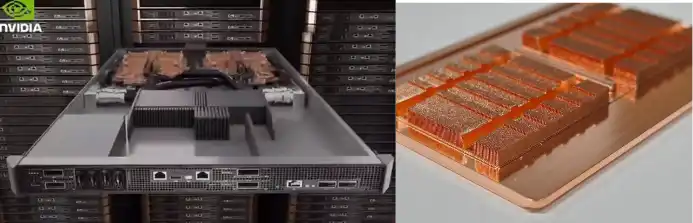
Figure 2: NVIDIA Server Module and Micro-channel Cold Plate
· Ecosystem-level Collaboration and Solution Certification: Engages in deep collaboration with top thermal management and infrastructure vendors like Vertiv and Boyd to jointly develop and certify cabinet-level liquid cooling solutions. For instance, Vertiv's Tier 2 Ready cabinet solution is a pre-validated product developed based on NVIDIA's blueprint, enabling data center operators to rapidly obtain a plug-and-play liquid-cooled cluster as easily as procuring standard equipment.
· Digital Twin Enablement and Deployment Acceleration: Leveraging the NVIDIA Omniverse platform, it provides digital twin and simulation tools for data center liquid cooling systems. Customers can design, verify, and optimize cooling solutions in a virtual environment, significantly reducing the cost and risk of physical validation and achieving agility from design to deployment.
To understand these two paths more clearly, their core differences are compared below:
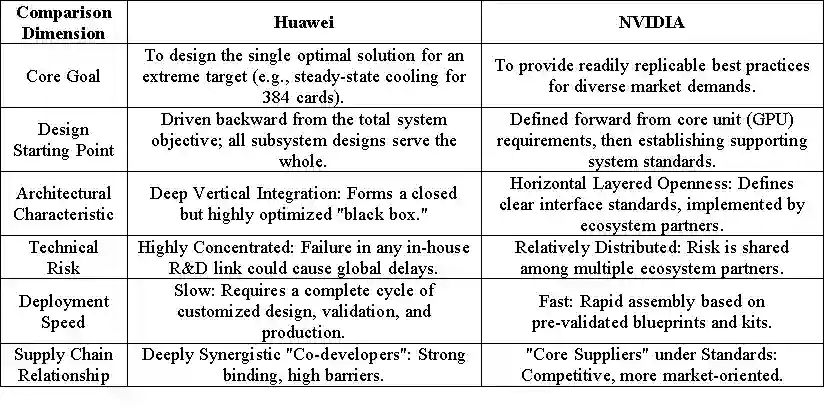
Table 2: Huawei Model vs. NVIDIA Model: Key Differences at a Glance
3- Historical Inspiration and Future Convergence
The competition between these two paths is not an isolated case in the history of technology. It is, in essence, another classic enactment of systemic integrated innovation versus platform-ecosystem innovation. Huawei resembles Apple during the Steve Jobs era, pursuing absolute control over the product experience from top to bottom. In contrast, NVIDIA is more like today's Google Android, driving the prosperity of an entire ecosystem by setting core standards (the Android system / GPU architecture).
For the industry, the future trend is not about one side completely replacing the other but likely involves a degree of convergence:
· In national or enterprise-level projects pursuing ultimate computing power, the allure of "Deterministic Systems Engineering" remains undiminished.
· In the vast commercial cloud computing market, "Agile Ecosystem Innovation" will continue to expand due to its speed and cost advantages.
· Sparks of ingenuity may emerge at the intersection: incorporating deeper customization and collaborative optimization within open ecological standards.
4- Conclusion
Therefore, the cooling debate between Huawei and NVIDIA is fundamentally a contest between two core competitive strengths in the AI era: one side pursues deterministic, extreme performance through the deep integration of systems engineering; the other drives agile industry innovation and rapid proliferation by building open standards and ecosystems. This duel delineates clear path choices for participants in the industrial chain: to act as a "spearhead force," deeply integrated and tackling specific system-level fortresses, or to serve as the "main force," integrating into the ecosystem to explore markets across the vast plains of standardization. Ultimately, victory lies not only in the technology itself but also in the insight into the logic of industrial evolution and a clear definition of one's position in the future blueprint.
We will regularly update you on technologies and information related to thermal design and lightweighting, sharing them for your reference. Thank you for your attention to Walmate.
Scan to follow
测试测试测试测试测试测试测试测试测试测试测试测试测试测试测试测试测试测试测试测试测试测试测试测试测试测试测试测试测试测试测试测试测试测试测试测试测试测试测试测试测试测试测试测试测试测试测试测试测试测试测试测试测试测试测试测试测试测试测试
测试测试测试测试测试测试测试测试测试测试测试测试测试测试测试测试测试测试测试测试测试测试测试测试测试测试测试测试测试测试测试测试测试测试测试测试测试测试测试测试测试测试测试测试测试测试测试测试测试测试测试测试测试测试测试测试测试测试测试
测试测试测试测试测试测试测试测试测试测试测试测试测试测试测试测试测试测试测试测试测试测试测试测试测试测试测试测试测试测试测试测试测试测试测试测试测试测试测试测试测试测试测试测试测试测试测试测试测试测试测试测试测试测试测试测试测试测试测试
测试测试测试测试测试测试测试测试测试测试测试测试测试测试测试测试测试测试测试测试测试测试测试测试测试测试测试测试测试测试测试测试测试测试测试测试测试测试测试测试测试测试测试测试测试测试测试测试测试测试测试测试测试测试测试测试测试测试测试
测试测试测试测试测试测试测试测试测试测试测试测试测试测试测试测试测试测试测试测试测试测试测试测试测试测试测试测试测试测试测试测试测试测试测试测试测试测试测试测试测试测试测试测试测试测试测试测试测试测试测试测试测试测试测试测试测试测试测试
测试测试测试测试测试测试测试测试测试测试测试测试测试测试测试测试测试测试测试测试测试测试测试测试测试测试测试测试测试测试测试测试测试测试测试测试测试测试测试测试测试测试测试测试测试测试测试测试测试测试测试测试测试测试测试测试测试测试测试
测试测试测试测试测试测试测试测试测试测试测试测试测试测试测试测试测试测试测试测试测试测试测试测试测试测试测试测试测试测试测试测试测试测试测试测试测试测试测试测试测试测试测试测试测试测试测试测试测试测试测试测试测试测试测试测试测试测试测试
测试测试测试测试测试测试测试测试测试测试测试测试测试测试测试测试测试测试测试测试测试测试测试测试测试测试测试测试测试测试测试测试测试测试测试测试测试测试测试测试测试测试测试测试测试测试测试测试测试测试测试测试测试测试测试测试测试测试测试
测试测试测试测试测试测试测试测试测试测试测试测试测试测试测试测试测试测试测试测试测试测试测试测试测试测试测试测试测试测试测试测试测试测试测试测试测试测试测试测试测试测试测试测试测试测试测试测试测试测试测试测试测试测试测试测试测试测试测试
测试测试测试测试测试测试测试测试测试测试测试测试测试测试测试测试测试测试测试测试测试测试测试测试测试测试测试测试测试测试测试测试测试测试测试测试测试测试测试测试测试测试测试测试测试测试测试测试测试测试测试测试测试测试测试测试测试测试测试
测试测试测试测试测试测试测试测试测试测试测试测试测试测试测试测试测试测试测试测试测试测试测试测试测试测试测试测试测试测试测试测试测试测试测试测试测试测试测试测试测试测试测试测试测试测试测试测试测试测试测试测试测试测试测试测试测试测试测试
测试测试测试测试测试测试测试测试测试测试测试测试测试测试测试测试测试测试测试测试测试测试测试测试测试测试测试测试测试测试测试测试测试测试测试测试测试测试测试测试测试测试测试测试测试测试测试测试测试测试测试测试测试测试测试测试测试测试测试
测试测试测试测试测试测试测试测试测试测试测试测试测试测试测试测试测试测试测试测试测试测试测试测试测试测试测试测试测试测试测试测试测试测试测试测试测试测试测试测试测试测试测试测试测试测试测试测试测试测试测试测试测试测试测试测试测试测试测试
测试测试测试测试测试测试测试测试测试测试测试测试测试测试测试测试测试测试测试测试测试测试测试测试测试测试测试测试测试测试测试测试测试测试测试测试测试测试测试测试测试测试测试测试测试测试测试测试测试测试测试测试测试测试测试测试测试测试测试
测试测试测试测试测试测试测试测试测试测试测试测试测试测试测试测试测试测试测试测试测试测试测试测试测试测试测试测试测试测试测试测试测试测试测试测试测试测试测试测试测试测试测试测试测试测试测试测试测试测试测试测试测试测试测试测试测试测试测试
测试测试测试测试测试测试测试测试测试测试测试测试测试测试测试测试测试测试测试测试测试测试测试测试测试测试测试测试测试测试测试测试测试测试测试测试测试测试测试测试测试测试测试测试测试测试测试测试测试测试测试测试测试测试测试测试测试测试测试
测试测试测试测试测试测试测试测试测试测试测试测试测试测试测试测试测试测试测试测试测试测试测试测试测试测试测试测试测试测试测试测试测试测试测试测试测试测试测试测试测试测试测试测试测试测试测试测试测试测试测试测试测试测试测试测试测试测试测试
测试测试测试测试测试测试测试测试测试测试测试测试测试测试测试测试测试测试测试测试测试测试测试测试测试测试测试测试测试测试测试测试测试测试测试测试测试测试测试测试测试测试测试测试测试测试测试测试测试测试测试测试测试测试测试测试测试测试测试
测试测试测试测试测试测试测试测试测试测试测试测试测试测试测试测试测试测试测试测试测试测试测试测试测试测试测试测试测试测试测试测试测试测试测试测试测试测试测试测试测试测试测试测试测试测试测试测试测试测试测试测试测试测试测试测试测试测试测试
测试测试测试测试测试测试测试测试测试测试测试测试测试测试测试测试测试测试测试测试测试测试测试测试测试测试测试测试测试测试测试测试测试测试测试测试测试测试测试测试测试测试测试测试测试测试测试测试测试测试测试测试测试测试测试测试测试测试测试